
🏗️ Abundant California
An operational framework for solving our state’s public problems at scale.


Editor’s Note: We started this Substack and our associated organization, Abundance Network, years ago because we saw lots of societal problems and wanted to play a productive role in fixing them. Over the years we’ve built a community of Bay Area private sector leaders—as well as public, private, and nonprofit leaders around the country—who contribute financial, social, and human capital to actualize institutional reform.
We are always looking to grow our community of private sector leaders who contribute to reform work, and our message to them is in part that they have a moral responsibility to engage because with power and resources comes a responsibility to maintain the public commons.
In 2025 my cofounder Zack Rosen wrote a memo to one such Bay Area private sector leader, outlining how to approach government reform work based on Zack’s experience at California YIMBY and Abundance Network. The memo was subsequently leaked to an org that publicly opposes Abundance, so we’re releasing an updated version of it here in full.
We stand by its core insights and hope it might influence the way private sector leaders engage in California political reform work going forward.

Introduction
California (40M population) is home to the most productive engine for growth in the global economy.
But that blessing has turned into a curse for our citizens—our civic leaders have failed to govern our state effectively in the 21st century.
Reversing this trend is a worthy and achievable goal.
This memo summarizes our approach and philosophy to this work via my experience as co-founder of California YIMBY, Abundance Network, and Pantheon.
Abundance is helping establish an emerging category of philanthropic capital yet-to-be named, but thought of as “public problem-solving at scale.” It is roughly analogous to the philanthropic capital organized and deployed 100 years ago during the Progressive Era when business leaders partnered with public leaders to build power in Municipal then State the Federal government 1910-1940. They then exercised that power to remake the American system of government for the Industrial era, win World War II, crush the totalitarian Soviets, and unleash the greatest wave of shared prosperity in the world until the China model of 19701980-2010.
The goal of this memo is to explain this alternative category of philanthropic capital clearly so you can decide if it’s a fit (or not) for your philanthropic capital allocation.
Quick context on my background: I have logged ~35,000 hours as a tech founder and ~20,000 as a political operative.
I worked on Howard Dean’s Internet team, which invented the campaign model that elected Obama President.
I co-founded and was CEO of Pantheon from $0 to $100M+ ARR. I built my career in tech to have the credibility to help private sector leaders be maximally effective in the domain of politics and government.
I co-founded California YIMBY, which is about 50% of the way through ending the California housing shortage—the most crippling public problem in the most important state in the United States of America.
I co-founded Abundance Network to scale the approach honed at California YIMBY across policy domains and jurisdictions that comprise the United States.
In my experience, many existing players in politics and government will struggle to modernize our public institutions on their own. It’s really hard work! Leaders from business—and allies in higher education and labor—must help public leaders figure this out in hands-on ways. Private sector leaders should learn how to apply the relevant parts of what we do in our day jobs to help transform our public institutions, and make them healthy and viable again.
The analog is what leaders from business did in 1910-1935 when reformers rebuilt the American government, designed for a 90% farm economy, for the Industrial era. Practices from running scaled industrial operations were painstakingly retrofitted to our American system of self government: bookkeeping, inventory management, professional civil service and scaled municipal infrastructure and services (e.g. police, fire, public health, roads, sewers)—all were designed, implemented, and scaled in a ~30 year period by a single generation of public leaders.
Strong POV: Policy Comes First, Marketing Comes Next
70% of your startup learnings will work beautifully in this public problem-solving work. 30% will blow you up. The difficulty is knowing the difference.
The basic thing we may disagree on is that policy is the product and campaigns are the sales & marketing function. To be effective, you need to understand how to work backwards from “a government change that improved people’s lives” to politics.
The product comes first, the sales and marketing (go-to-market functions) come second. All the tricky political and coalition questions—what is the political identity, the party coding, which candidates and races etc.—come after you lock in your policy goals and roadmap.
Building a political team that does not have a policy team—or policy goals—is like building a startup with sales & marketing but no engineers or product managers or designers. It won’t work.
Unfortunately this is standard practice.
Next, you need to understand how coalitional power is built and exercised. This is the key concept you will need to be effective. CEOs/VCs often can’t get their head around this, but it’s the core difference in driving outcomes via democratic institutions (government) v.s. ~autocratic institutions (companies).
With tech companies the market winner gets 50%+ of the market power, and everyone just standardizes on them. In politics, the hard lines of power are hyper-fractured and so you need to agglomerate power via coalitions. Our system of self-government is built around interlocking mechanisms of power that scaffold together into a larger whole.
The methodology and capability of getting these interlocking bodies to agree is the basis of building and exercising coalitional power. One regional body controlled by its elected members can simply say “no” to the thing you want to accomplish: city council, MTC board, legislative committee etc.
Coming from the private sector, this form of coalitional power building can be foreign and off-putting and maddeningly slow. It has taken me a long while—with tons of mistakes along the way—to start to learn how power is effectively exercised in the American system of government. I’m still learning.
It’s sad to say, but at this point I believe the average philanthropic involvement in government reform work has been net-negative. For example, philanthropists in L.A. tanked their housing market (via measure ULA) and may end up accidentally forcing a state-wide ballot prop to set revenue measures to 66% again, which would cause wreckage in municipal governments up and down the state. And up close, ~80% of the traditional philanthropy being poured into San Francisco is relatively ineffective, or put into things that unintentionally make it harder not easier to govern our city.
These examples are downstream of structural issues that enabled the “Non-Profit Industrial Complex” to dominate policy in left-leaning jurisdictions, to the detriment of their represented constituents. In California, foundations outspent the YIMBY movement $260M to ~$40M backing groups that oppose housing.
Money in California Politics
There are many examples of wealthy folks growing frustrated with the status quo and jumping into political reform efforts with gusto. These efforts tend to be relatively short-lived and ineffective. Why?
If you are a funder you have probably logged >25,000 hours building your wealth. The minimum buy-in for building a successful operation solving public problems at scale is 5,000-10,000 hours. Most funders don’t roll up their sleeves to figure out how the system of government and politics actually works. Instead they pair private sector mental models with political consultants and burn through money.
In our view there are three styles of political investing:
Gambling: Donate to an elected, hope for the best. Most hard money is this. (ActBlue etc.)
Card Counting: Hire an expert and make risk-adjusted bets. ← This is the default for a new funder.
The House: Get a 2pt edge and sustain it. The big stuff has to be done this way (e.g. overturning Roe vs. Wade in the courts despite it being 2:1 unpopular)
← This is what Abundance is building, but in pursuit of majoritarian goals!1
Narrow interests are very entrenched and powerful—they will outspend reformers 10:1 or 100:1. But we have a track record of out-executing opponents with that lopsided spend. This is analogous to how startups can out-execute big legacy companies. You focus, you move fast, you stage capital smartly. Reforming institutions requires the same entrepreneurial spirit of startups—but it’s rare to find this approach in the domain of public problem-solving.
Framework for Deploying Public Problem-Solving Capital
There are three boxes you should check before you greenlight funding:
A Do you understand the policy levers to pull to create the outcome?
B Do you have the political power necessary to pull the levers?
C Do you have the resources (talent, money) to sustain the political power necessary to pull the levers?
Here is a framework—questions to answer—to check boxes A and B. You will need an experienced team to build the plan and work-back for C.
Question #1: What is your goal?
Recently we’ve heard funders reference the Fairshake campaign as a success model. I have only passing knowledge of the Fairshake campaign, but as far as I understand it was a straightforward lobbying effort to push back on crypto regulation via Federal authorities. Regardless of the merits of the policy position, it’s a great example of “working backwards from a government change.” Very clear and actionable.
My first question is, who was the counterparty? (e.g. who wants to regulate crypto) Perhaps banks were pushing to regulate, in which case this would be a meaningful fight. If not, and it was only pro-finance-regulation orgs, then I am less impressed, as those groups are quite weak in D.C.
In any case, you should start by answering this question:
Goal: [Action X] to [Change Y]
For Fairshake, it was something like:
Goal: Lobby Congress to Stop Crypto Regulation.
For California YIMBY it is
Goal: Lobby California State Legislature to Legalize Housing
How do you frame your goal? Often times projects get funded with no more than this:
Goal: Buy Political Advertisements to Elect “Better” Politicians
Two things to point out here: (1) Helping get aligned politicians elected is a step on the way to a policy outcome, not a policy outcome itself (2) You can only know who an “aligned” or “better” politician is once you clearly define “better.”
This is what I meant by “working backwards from government change” to politics. The campaign consultants are like Account Executives. They will sell you activities all day long—and pocket 5-15% of your advertising spend—without forcing you to identify your goal.
Question #2: What is the jurisdiction to achieve your goal?
For Fairshake it was (I believe) Congress and presumably Federal regulatory bodies.
For California YIMBY it has been the State Legislature passing statewide policy that Municipal Governments (in theory) need to follow.
For each goal, you need to map the jurisdictional authorities who control what you want to do. This means intersecting all levels of government, from the Supervisor district, the Municipal code, to regional authorities (MTC etc.) to State to Federal Statutes.
This takes real policy expertise that goes well beyond what almost all political consultants have.
Question #3: How will you build the political power to influence the jurisdictional bodies to achieve your goal?
Now that you have mapped the jurisdictional bodies, you can begin the political work back. Each body will need its own plan.
Example: Ending the Housing Shortage in California
At California YIMBY we weren’t the first people to understand the housing shortage was immiserating Californians. But we were the first to make major progress ending it.
How?
Here is a good state-of-play on housing from Bloomberg. I co-founded California YIMBY with Brian Hanlon and Nat Friedman in 2017. We are about ~halfway through solving the housing shortage in California, which is the nexus of horrible outcomes for Californians.
We built north of 200,000 new homes per year in the 1950s with a population under 10M. We are building 80,000 homes today for a population over 40m. Why? Because we made it illegal to build new housing 1970-2020 while California philanthropies either sat on their hands, or worse, invested in NIMBY activist organizations on the basis of supporting “equity.”
The difficult thing on housing is that you need to bore a giant hole through 4 domains of land-use policy in order to enable the market to come back. Essentially we need to undo 70 years of NIMBY land-use policy that covers every jurisdiction in heavy layers of red tape. Once we complete these tasks, cranes 🏗️—the sentinels of Abundance—will be visible across California’s cities:
Ministerial Approval (~85% complete): If your project is legal, can you build it? Or can a local City Council member or neighborhood activist still veto the housing? With the housing exemption from CEQA and HAA strengthening we are now “de facto ministerial,” which means in California if your project is legal, nobody can stop you from building. This was the hardest political lift we will have to do, as we had to defeat the “exaction-machine” of equity groups, a subset of labor2, and NIMBYs etc.
Zoning (~60% complete): Is it legal to build your project? With SB79 and strengthening the RHNA process we have upzoned high-demand cities via the largest up-zoning in the history of the United States.
Fees (0% complete): Today builders face fees of +/- $200,000 per home in high demand California cities. This is basically the cost of building a home in Ohio. We are turning our focus to this work in ‘26.
Implementation (10% complete): Building codes, power/water/sewer hookup, plan-check etc. Have you experienced San Francisco Department of Building Inspections? Abundance Network will likely pick up some of this work because it’s at the Municipal level of government (it will be a long-tail of work.)
Until all 4 layers are cleared, you don’t get much. However, we have successfully punched through all 4 layers for ADUs.
Boom:
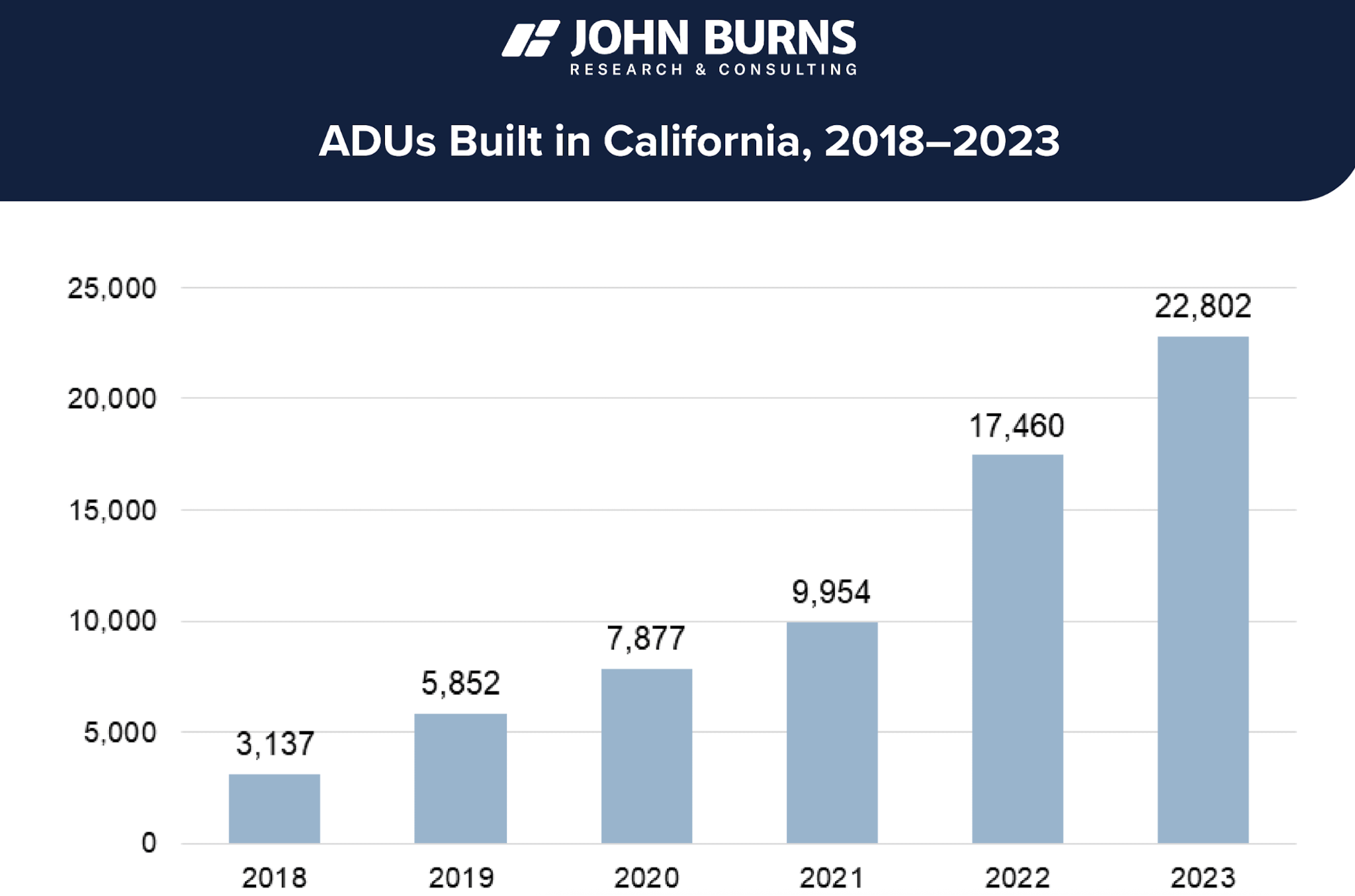
That’s a fast-growing $3-4B/year market we enabled via government change. When we punch through on Multifamily, we’ll open up a $100-$200B+/market, building 250,000+ new homes per year for current and future Californians.
Access to economic opportunity is the core of the American dream. We are on path to restoring that access for the most important agglomerations of talent and industry in the United States.
How are we doing this?
We professionalized the YIMBY movement.
We were right on the policy merits, and won the narrative by nationalizing the conversation. We got the NYT, Bloomberg etc. to write the same article every week for years to the effect of “Watch California, the crown jewel of the American economy, screw it up because of their housing shortage.”
We de-powered the NIMBY-aligned narrow interests over time.
This work is being led by a 15-person land-use-policy crew based in the Bay Area. Most of it was funded by tech founders.
The key to our success was being rigorous about the workback. Everything flowed from clearly articulated policy goals, choosing the right political jurisdiction, and being dogged in our political execution as we nurtured the pro-housing coalition in the California legislature.
There was lots of trial and error and blowups and learnings along the way. But 90% has just been hands-on execution. “Work works.” All of this is repeatable and scalable.
It took us 7 years to get 50% of the way through the 4 layers. It will take another 7 years to complete the job… unless the cavalry comes, in which case we think we can pull it off in 3-4 years. Specifically, other HNWI funders and more helpfully if the corporate government relations teams from Google, Meta, Apple got substantively involved.
The Goal: Reinvent our Public Institutions
Our shared goal is simple but ambitious: to reinvent America’s public institutions—especially governments at the local, state, and federal levels—so they can meet the demands of the 21st century. That means building the foundational infrastructure our economy runs on—power, housing, transportation—and delivering the essential services people rely on—education, healthcare—at a consistently high standard.3 If we get this right, we unlock an era of true abundance, where innovations from the private sector demonstrably improve the lives of every American in a durable, positive-sum way.
Our inability to deliver abundance—and our tendency to let institutions get trapped in zero-sum conflict—is driving the political instability crescendoing in our national politics. Democrat-controlled states have a product problem, not a messaging problem: the lived experience of residents doesn’t match our stated values. Democrats are susceptible to believing their own talking points over demonstrable performance, instead of taking a curious, humble, outcome-focused look at what’s working and what isn’t across different governing models, including both MAGA-aligned and Democrat-controlled jurisdictions.
It’s a sad state of affairs that voters have to choose between (A) MAGA states that are delivering economically progressive outcomes on at least some measures or (B) Blue states that claim progressive values but often fall short.
For example:
Texas is now crushing California in their clean energy build out.
Mississippi through the civic leadership of Jim Barksdale went from worst-in-the-nation education performance to best-in-the-nation4 while California has backslid.
California has the highest rate of poverty in the United States.5
Blue States are falling behind in governing our public education systems relative to Red States.
In the end, what matters in governing is not what you say, or your self-conception, but what you deliver. There is no one to blame for the failures of liberal self-government but ourselves.
Our goal with Abundance is to position the brand as the leading alternative to “MAGA” on the right and “The Groups” on the left by the 2028 election cycle. But, critically, the brand promise of Abundance must not get ahead of our ability to ship “product” (aka outcomes that improve people’s lives) across the jurisdictions that comprise the United States of America.
It took the conservative movement 16 years to rebuild themselves, from getting crushed in ‘64 (Goldwater) to triumph in ‘80 (Reagan). The interstitial step was the California conservative movement ‘67-’75 built by Reagan’s faction.
Success for Abundance is not winning the Presidential election in 2028. It is changing and renewing our government to enable a new era of abundance for the United States of America. Premature scaling will kill it.
Scaling Abundance Nationally
We have a “show not tell” approach to our work. Our approach is analogous to a startup operating in stealth-mode for five years to find product/market fit. Now that we have found it—demonstrable traction in multiple jurisdictions and accelerating demand for Abundance—funder interest is growing.
Before we speed up and deploy “Series B capital,” we need to clearly explain what we’re doing and make sure our stakeholders—especially our funders—are aligned with us and our operating model.
Over the past few years, Abundance has garnered important institutional support6 to scale Abundance across all 50 States, and across many policy domains—starting with housing, energy, and transportation. This is the core infrastructure you need to build in the country—from municipal government, up to state, up to federal.
This is the only reasonable way we can retool the American system of government for the modern era. We are in the early stages of this retooling. We know how to change government via regulation. But we do not yet have the playbooks for modernizing human-capital bound government delivery. (e.g. police, education, transit, public health)
Building Institutional Power for Abundance in California
Our system of American self-government is built around the mechanisms of institutional power: the courts, federal congress, state legislative bodies, regional bodies, municipal bodies on down. The only way to structurally change government is to interface with it at the right level of jurisdictional power. This requires designing, building, and scaling institutional power in a way that is deliberately mapped to the architecture of our system of self-government.
This is why unions, NRA, ACLU, and all scaled institutions that exercise political power across the United States are architected in a federated model. If you do not architect this in from the beginning, your ability to shape government will be severely curtailed at scale.
In addition, it’s far more effective to deploy less capital in a sustained manner—over decades—than a large infusion of capital that fades quickly. This is because our systems of self-government are interlocking, and institutional power is exercised via coalitions, and coalitions are only formed by sustained commitments. Examples:
The NRA’s commitment to the GOP
The Pro-Choice movement’s commitment to the Left
Public sector unions’ sustained operations in Municipal and State governments
This is why when you meet electeds and you cannot demonstrate your staying power they will discount your ability to execute by 90%. Your counter-parties will be at the table for the electeds’ entire career and have long memories. Experienced electeds see donors come and go all of the time and will rightly assume you will not be around after a couple cycles.
Said differently: institutional political power can only be built on ~permanent capital streams.
Summary
California’s political system is too entrenched for traditional philanthropy—progress requires 10:1 or 100:1 leverage through institutional power, not campaigns or messaging.
A new category of philanthropy is emerging: “solving public problems at scale,” akin to the Progressive Era when business leaders helped government leaders and other reformers rebuild government for the Industrial age.
Most donors fail because they fund marketing without a product—policy must come first, politics second, and efforts must work backward from specific government changes.
Power in government is fractured across jurisdictions, so success comes from assembling coalitions across city, regional, state, and federal bodies—not from winning elections alone.
The California YIMBY project shows the model works: with ~$5M/year, it has solved ~50% of the housing shortage by systematically drilling through four layers of land-use policy.
Completing the remaining layers will unlock a $100–200B/year housing market and restore access to opportunity for millions—accelerated if new funders join the effort.
Abundance Network is helping scale this model nationally as part of a nascent ecosystem, building municipal-to-state-to-federal institutional power.
Performance, not ideology, drives trust: blue states have a product problem, and red states are often delivering progressive outcomes better than Democrats’ strongholds.
Durable political change requires permanent, federated institutions and sustained capital streams—not one-off donations—because electeds only trust partners who stay for decades.
I hope some of these learnings are useful as you explore how you want to get involved in government reform efforts. If you think there are opportunities to collaborate, reach out!
One way to frame Abundance is in reaction to narrow interest capture which privileges Minoritarianism.
We partner very closely with the North Coast States Carpenters Union, who are Abundance-aligned. But we’ve been on opposite sides of the Building Trades Unions in many housing fights over the years, though that is starting to change.
In some cases directly, and in some cases via properly structuring markets to private sectors actors can deliver these goods.
“After adjusting for demographics, in 2024, Mississippi was the nation's #1 state in reading as well as in mathematics.” https://en.wikipedia.org/wiki/Mississippi_Miracle
Here we mean the Supplemental Poverty Measure (SPM). Unlike the official poverty measure, it factors in geographic cost of living, housing costs, taxes, and non-cash benefits. Because of California's high cost of living, the state consistently ranks near the top (highest poverty rate) under the SPM, despite ranking much lower under the traditional measure.
Examples include Coefficient Giving’s Abundance & Growth Fund, Arnold Ventures’ Infrastructure Fund, and the Recoding America Fund.
“… and unleash the greatest wave of shared prosperity in the world until the China model of 1970-2010.”
I know that you want to signal that you are a good leftist and play up the undeniable economic growth in China, and I understand that the fact that it was mostly about moving away from destructive left authoritarian policies plays to your message.
But you may want to consider updating the start date from 1970 to either 1977 (after Mao’s death) or even better 1979 (after Deng takes charge and reforms really start).
Growth was already positive albeit chaotic under late Mao, it’s true. But it was after Deng’s reforms began when it jumped to roughly 10% real annual growth for the next three decades.
Politics is not a product problem. It's a people problem. Any discussion of politics that strips the human being from the center of the political change at hand seems more theoretical and less genuine from folks in the trenches. Coalitions are negotiated among existing organizations. Networks of people grow by getting new people involved. The funding critique has merit but if the response of wealthy sector founders deploying capital more strategically only replaces one set of funders with another.
How do you build up and uplift the needs and energy of the affected communities? Seems to be the true way out of this mess. The model that starts by asking communities to align with a pre-set policy agenda developed by tech founders sets off red flags. Any strategy that ultimately creates deeper dependencies on a narrower funder base is increasing fragility and decreasing democratic accountability.
This seems to be another top-down funder-captured approach that mistakes sustained lobbying infrastructure for a genuine popular movement and, in doing so, undermines the kind of distributed, culturally influenced, long-term power that actually wins and sustains progress.